What Happens When a Non-Developer Takes AI Coding Tools Seriously
I’ve spent nearly ten years in the IT industry. Vendors, start-ups and distributors.
I’ve sat in architecture sessions, scoped integration projects, and translated technical decisions for executives who needed to understand what they were buying.
I understood how systems worked.
I could reason about APIs, databases, and cloud vs on-prem trade-offs. I could whiteboard a solution and explain why one approach was better than another. Years of pattern recognition came from watching solution engineers, architects & developers plan real systems.
But I had never written production code.
Beyond a “Hello World” script and some aggressively over-engineered Excel macros, I was a non-developer. And like most people in that position, I assumed any serious product idea would stay exactly that: an idea.
The Idea Wouldn’t Let Go
CityHenge helps people find moments when the sun or moon aligns perfectly with city streets, creating long corridors of light.
Think Manhattanhenge, but for any city with a grid.
These moments happen constantly. Almost nobody knows when or where to look.
I wanted an app that could calculate solar and lunar positions, map them against street bearings, and tell you where to go and when to be there.
But I also wanted to build something intentionally different.
No infinite scroll. No points. No streaks. No feeds optimised to keep you staring at a screen.
The goal was simple: get people somewhere, then get out of the way. Put the phone in your pocket. Watch the light change.
Technically, this was not a beginner project. It required astronomical calculations, geospatial queries, interactive maps, authentication, notifications, backend APIs, and a cross-platform mobile app.
This was not a tutorial.
The Old Barriers Were Clear
There were only three traditional paths forward.
Hire an agency or freelance devs.
Find a technical co-founder.
Learn to code properly first.
Realistically a year or more before building anything meaningful.
In November 2025, I tried a fourth option.
I opened Claude Code and started describing the system I wanted to build.
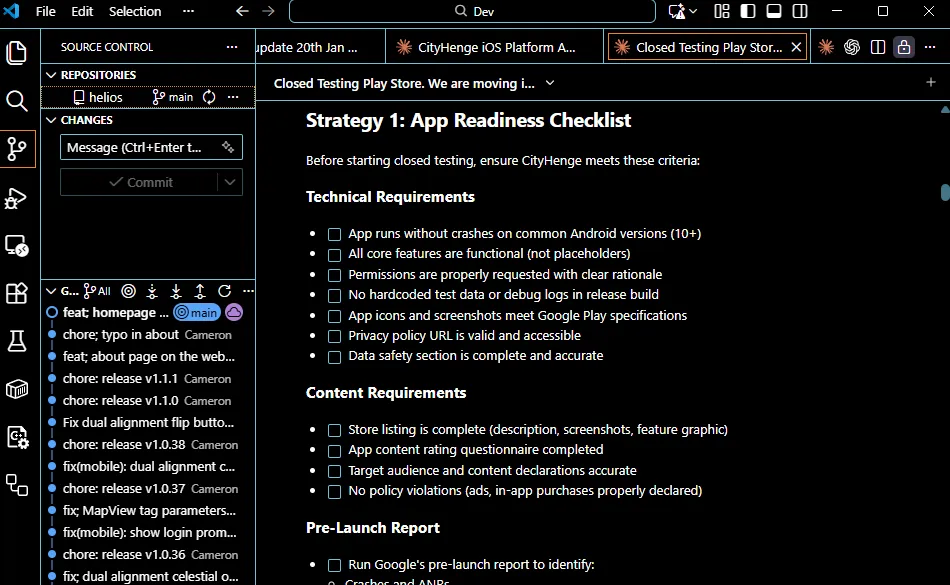
Two Months Later
Two months later, I had a functioning mobile app.
A React Native frontend. A FastAPI backend. PostgreSQL with PostGIS for geospatial queries. Mapbox integration. Firebase authentication and push notifications. Astronomical calculations using Ephem and Astral. 188,000 lines of code and 400+ git commits.
Seventeen Australian cities.
Not a prototype. Not a mockup. A real product now in closed beta, launching publicly in mid-February.
What AI Coding Actually Looks Like
This was not magic.
But if I had the ideas, I had a collaborator who could implement the “how.”
When something failed, we diagnosed it together. When I didn’t understand something, I asked for more information and implications. When Claude didn’t get things right, I provided more detail on the outcome I wanted and context on what we’d tried previously.
I learned more about software development in two months than in my previous decade of adjacent exposure.
The wall between “I understand systems” and “I can build systems” collapsed.
If You Work in IT, This Part Matters
If you’ve spent years in IT, your mental models and vocabulary already matter.
You understand how data flows between services. You know the questions to ask about current state and future state. You’ve seen integrations fail in predictable ways.
That knowledge used to be necessary but not sufficient.
Now, the missing pieces can be augmented.
This wasn’t outsourcing thinking to AI. It was being able to think while building instead of before building.
The Exciting Implication
Here’s the real takeaway.
If you work in IT and genuinely understand how software systems work, you can now build software.
Not toys. Not demos. Real applications.
The gap between “technical-adjacent” and “technical” has narrowed dramatically.
Solution architects. Product managers. Pre-sales engineers. Technical account managers. Consultants. Dare I say, even salespeople!
If you’ve spent years reasoning about systems without implementing them, you now sit much closer to execution than you probably realise.
This does not replace professional developers. Complex systems, scale, security, and team coordination still demand deep expertise.
But the threshold for building something real and useful has dropped to a level that would have sounded absurd two years ago. And it’s only getting easier.
CityHenge Today
CityHenge is currently in closed beta, with a public launch planned for mid-February.
It supports seventeen Australian cities, with sunrise, sunset, and moon alignments, plus a lightweight journal for capturing moments.
I’m looking for beta testers.
If you’re in Australia and curious whether a non-developer using AI tools can build something genuinely useful, I’d appreciate your help. And you’ll probably see some lovely sunsets if you use the app :)
Join the beta: https://cityhenge.com/testing
The Shift That’s Already Happened
The tools have changed.
Understanding technology is no longer a spectator sport. The distance between ideas and implementation has shortened dramatically, and it isn’t going back.
If you’ve been sitting on an idea because you “aren’t technical enough,” that excuse has an expiration date.
The interesting question now isn’t whether non-developers can build software.
It’s what they’ll choose to build, now that they can.
In my next few articles, I’ll use CityHenge as a live case study to explore what the shift to AI development looks like in practice for a solo developer.
Next up: exactly how much it cost to get CityHenge from zero to closed beta. Infrastructure, APIs, maps, AI tooling, mistakes, and the costs nobody mentions.